El rendimiento RF de un tag BLE se determina fundamentalmente antes de transmitir el primer paquete. La adaptacion de antena, la seleccion del material de la carcasa y la geometria de la antena en PCB determinan colectivamente si un tag logra una sensibilidad de -85 dBm a 20 metros o se reduce a 3 metros. Este articulo proporciona una guia para ingenieros de diseno para cuantificar y optimizar estos parametros con datos de medicion practicos.
Adaptacion de antena: diagrama de Smith y perdida de retorno
Una antena mal adaptada refleja la potencia de transmision de vuelta al PA, reduciendo la potencia radiada y danando potencialmente el radio. La metrica clave es la perdida de retorno (o S11), idealmente <-10 dB en toda la banda ISM de 2,4 GHz (2400-2483,5 MHz).
La adaptacion en red Pi (C-L-C) es el enfoque estandar para alimentaciones de antena de un solo extremo. Valores de componentes para un sistema de 50Ω:
# Target: 2400-2480 MHz, S11 < -10 dB
# Pi-network: C1 - L - C2
# For a typical 15x6mm PCB meander antenna (Z_ant ~ 30+j80 Ω):
C1 = 1.2 pF (01005 package)
L  = 5.6 nH (high-Q RF inductor, 0201)
C2 = 0.8 pF (01005 package)

# Measurement with VNA (NanoVNA or similar):
# 1. Calibrate with open/short/load at antenna feed point
# 2. Measure S11 across 2.0-3.0 GHz
# 3. Adjust C1/C2 iteratively to move Smith chart trace inside VSWR 2:1 circle
| Tipo de antena | Ganancia pico (dBi) | Ancho de banda S11 | Area de PCB req. | Omnidireccional? |
|---|---|---|---|---|
| Meandro (traza PCB) | 0.5 dBi | 2400-2483 MHz | 15×6 mm | Aprox. |
| Antena de chip (Johanson 2450AT42A100) | 1.8 dBi | 2400-2500 MHz | 10×3 mm + exclusión | Sí |
| PCB Inverted-F (IFA) | 2.1 dBi | 2300-2600 MHz | 20×10 mm | Buena |
| Chip ceramico (Yageo ANT3216LL00R2400A) | 1.2 dBi | 2400-2483 MHz | 3.2×1.6 mm | Sí |
Material de la carcasa: analisis de perdida dielectrica
La carcasa que rodea la antena del tag BLE introduce una carga dielectrica, desplazando la frecuencia de resonancia y reduciendo la eficiencia. El parametro clave es la permitividad relativa (εr) del material y la tangente de perdida (tan δ).
| Material | εr | tan δ (@2.4GHz) | Impacto en eficiencia de antena | Caso de uso |
|---|---|---|---|---|
| Aire (referencia) | 1.0 | 0 | 0 dB (linea base) | N/A |
| Plastico ABS | 2.4-2.8 | 0.006 | -0.3 dB | Uso general |
| Policarbonato | 2.9 | 0.008 | -0.5 dB | Resistente a impactos |
| Nylon (seco) | 3.5 | 0.02 | -1.2 dB | Alta temp. |
| Epoxi (FR4) | 4.5 | 0.025 | -2.0 dB | Sustrato PCB |
| Agua (exposicion 60% humedad) | 80 | 0.15 | -8 a -15 dB | Evitar proximidad |
Regla de diseno: Mantenga la antena a >5 mm de cualquier dielectrico con εr > 2.5. Para tags vestibles, el cuerpo humano (εr ~ 55) causa un desajuste de >10 dB: use una orientacion de antena invertida o una traza de antena 3D (fuera del plano) para minimizar la absorcion del cuerpo.
Medicion del diagrama de radiacion: patron 3D y nulos
Un tag BLE a menudo se orienta aleatoriamente en el espacio. Comprender el diagrama de radiacion 3D revela los «nulos» donde el tag es efectivamente invisible para la pasarela. Procedimiento de medicion en una camara anecoica (o sitio de prueba de campo abierto):
# Far-field measurement (@3m distance)
# Rotate DUT on 3-axis positioner
# Measure received power at each (phi, theta) angle
# phi: 0-359° (azimuth), theta: 0-180° (elevation)

# Example: nRF52840-DK with PCB meander antenna
# phi=0° (x-z plane): main lobe at theta=60°, null at theta=180° (-25 dBi)
# phi=90° (y-z plane): main lobe at theta=45°, null at theta=170° (-22 dBi)
#
# Worst-case null depth: -25 dBi (signal 300x weaker than main lobe)
# => Gateway must have >3 antennas (spatial diversity) to avoid blind spots
Implicacion practica: Un tag con antena meandra sujetado «plano» (plano de PCB paralelo a la pasarela) puede experimentar una reduccion de ganancia de 15-20 dB. Para estanterias de almacen, oriente la antena verticalmente (PCB perpendicular a la estanteria) para maximizar la ganancia hacia la pasarela.
Diversidad espacial: MIMO y seleccion de antena
Las pasarelas de antena unica sufren nulos por multicamino. Agregar una segunda antena (diversidad espacial) mejora el presupuesto de enlace en ~3-5 dB en entornos de desvanecimiento Rayleigh. Configuracion de pasarela de doble antena:
| Config. de antena de pasarela | Ganancia de diversidad Rx | Costo de implementacion | Mejor para |
|---|---|---|---|
| Monopolo unico | 0 dB (linea base) | $0.50 | Corto alcance (<10m) |
| Doble monopolo (espaciado λ/2) | +3.5 dB | $1.20 | Medio alcance (10-30m) |
| Doble monopolo (espaciado λ/4) | +5.2 dB (menor correlacion) | $1.20 | Multicamino en interiores |
| Parche + monopolo (pol. ortogonal) | +6-8 dB | $3.50 | Largo alcance (>50m) |
Calculo del presupuesto de enlace: de la antena a la pasarela
La ecuacion fundamental para la estimacion del alcance BLE:
Link Budget (dB) = P_tx + G_tx + G_rx - L_fs - L_misc - M_d

Where:
P_tx    = TX power (dBm), e.g. 0 dBm
G_tx    = TX antenna gain (dBi), e.g. 0.5 dBi
G_rx    = RX antenna gain (dBi), e.g. 2.1 dBi (patch)
L_fs    = Free-space path loss = 20log10(d) + 20log10(f) + 32.44
At 30m, 2.45GHz: L_fs = 20log10(30) + 20log10(2450) + 32.44 = 65.5 dB
L_misc  = Misc losses (cable, mismatch, body) = ~8 dB
M_d     = Fading margin = 15 dB (95% reliability, indoor)

Example (30m, line-of-sight):
LB = 0 + 0.5 + 2.1 - 65.5 - 8 - 15 = -86.9 dBm
Required RX sensitivity: -87 dBm (nRF52840: -96 dBm → OK, 9 dB margin)

Example (100m, outdoor):
L_fs = 20log10(100) + 20log10(2450) + 32.44 = 80.5 dB
LB = 0 + 0.5 + 2.1 - 80.5 - 3 - 10 = -91.9 dBm
Margin: -91.9 - (-96) = 4.1 dB (marginal)
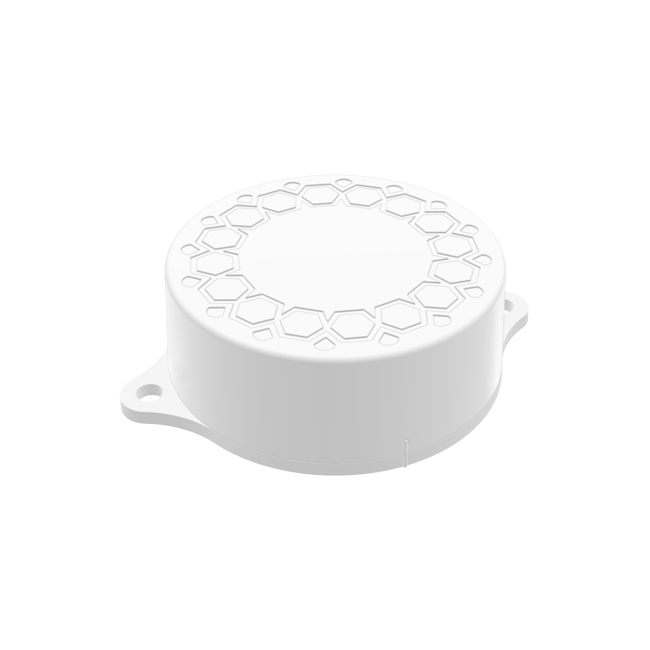
Diseno de la carcasa: zona de despeje de la antena
La zona de exclusion («keepout») alrededor de la antena es critica. Para una antena de λ/4 (λ/4 ≈ 30,6 mm a 2,45 GHz), el radio de la zona de despeje debe ser >15 mm en todas las direcciones. Directrices practicas de carcasa:
- Zona de antena: ninguna pieza metalica dentro de 15 mm (bateria, tornillos, inlay RFID)
- Espesor de la pared de la carcasa: ≤2 mm (ABS/Policarbonato)
- Etiqueta/impresion: evitar tinta metalica dentro de 10 mm de la antena
- Montaje: usar adhesivo no conductor (3M 300LSE) o separadores
Pruebas OTA: metricas TRP y TIS
Las pruebas Over-the-Air (OTA) en una camara miden la potencia radiada total (TRP) y la sensibilidad isotropica total (TIS). Estas son el estandar de oro para cuantificar el rendimiento RF en el mundo real:
| Metrica | Definicion | Objetivo tipico | Estandar de prueba |
|---|---|---|---|
| TRP (dBm) | Potencia TX radiada total (integracion esferica) | >-18 dBm (0 dBm TX) | 3GPP TS 34.121 |
| TIS (dBm) | Sensibilidad RX promedio sobre esfera | <-82 dBm | 3GPP TS 34.121 |
| Variacion TRP | TRP en todas las orientaciones | <3 dB (buena omnidireccionalidad) | Spec interna |
Validacion previa a produccion: Mida TRP/TIS a 3 frecuencias (2402, 2440, 2480 MHz) en 3 orientaciones del DUT. Si TRP <-22 dBm, la adaptacion de antena o el diseno de la carcasa necesita revision antes de la produccion en volumen.
Flujo de trabajo de ajuste practico
- Disenar la antena en PCB en CAD (KiCad/Altium) con simulacion EM 3D (openEMS o Ansys HFSS si el presupuesto lo permite)
- Fabricar 5 placas prototipo; medir S11 con VNA
- Iterar la red de adaptacion (C1/L/C2) para lograr S11 <-10 dB en toda la banda ISM
- Colocar en la carcasa de produccion; volver a medir S11 (efecto de desintonizacion de la carcasa)
- Camara OTA: medir TRP/TIS; ajustar la carcasa si TRP <-20 dBm
- Prueba de produccion: cada unidad medida para S11 a 2440 MHz (aprobado/fallado: S11 <-6 dB)
La alineacion RF para el Bluetooth Beacon y el Bluetooth Beacon es tanto ciencia como iteracion. Las herramientas y calculos anteriores (adaptacion con diagrama de Smith, presupuesto de enlace, metricas OTA) proporcionan un marco cuantitativo para optimizar el rendimiento en el mundo real. Nuestro equipo de ingenieria RF ofrece revision de diseno de antena y pruebas OTA de pre-conformidad: contactenos para discutir su proyecto de Bluetooth Beacon.