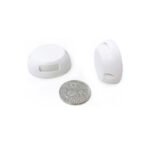

What Exactly Is a Beacon Transmitter?
A beacon transmitter is a thumb-sized Bluetooth Low Energy radio that broadcasts a short packet at fixed intervals—typically once per second—without ever expecting a reply. It contains a crystal oscillator, a copper antenna, and a DC-DC converter that wrings every last drop from a CR2032 cell. The entire transmission lasts a few milliseconds, after which the device sinks into nano-amp sleep until its next scheduled burst.
The Anatomy of a Broadcast
Inside the plastic shell, a CMOS radio wakes, pumps 0 dBm into the antenna, and shuts down within 5 ms. A 31-byte payload carries a 128-bit UUID, major/minor numbers, and a one-byte RSSI reference. No pairing, no handshakes, no encryption keys—just a brief declaration that something is present at a known calibrated distance.
Power Budget: Micro-Amps, Mega-Years
At 1 Hz the average current is 5 µA; stretch the interval to 10 s and the same coin cell crosses the five-year line. Some vendors add photovoltaic strips under store spotlights, pushing replacement intervals into decades. The design rule is simple: broadcast only when necessary, sleep the rest of the time.
Antenna Design: Gain Without Pain
A meandered PCB antenna on high-Q FR4 delivers +2 dBi while occupying 8 × 12 mm. That extra gain translates into 25 % less transmit current for the same range. Engineers often bias the trace slightly off-resonance so the PA outputs only −8 dBm instead of 0 dBm, cutting peak current from 8 mA to 3 mA without sacrificing 10 m of coverage.
Calibration: Speaking at the Right Volume
Each unit is trimmed on the production line, storing a correction factor in EEPROM so the one-byte RSSI value embedded in the packet matches the actual signal strength at one metre. Miscalibrate by 3 dB and your “unlock at 1 m” becomes “unlock at 1.5 m”—enough to frustrate users and drain batteries faster.
Security in a Single Breath
Rolling identifiers rotate every 15 minutes, seeded by a 64-bit factory fuse that cannot be read externally. Over-the-air updates are signed with ECDSA; rollback protection fuses old firmware hashes into silicon. The result is a device that can be trusted even though it never pairs, never encrypts, and never asks for a password.
Real-World Voices
In a European supermarket, a transmitter glued under a shelf talks to self-checkout screens; when the basket is within 30 cm, the terminal unlocks. In a Madrid hospital, infusion pumps tagged with waterproof units open only when a nurse’s phone is within 50 cm, preventing drug errors. On a 20-hectare mine site, solar-powered transmitters bolted to light towers log the proximity of tagged helmets, sounding an alarm if a worker wanders into a blast zone.
The Road Ahead: Zero Maintenance
Printed antennas on recyclable cardboard, MEMS energy harvesters that scavenge micro-watts from HVAC vibrations, and Bluetooth 6.0 channel-sounding will push accuracy to centimetres while keeping the duty cycle below 0.01 %. The transmitter of tomorrow will be born, live, and die within the envelope it was shipped in—an ephemeral lighthouse that quietly retires itself when the building is torn down.
Conclusion: The Long Hum
A beacon transmitter proves that information does not need volume to travel—it needs patience. By stretching time and squeezing watts, it turns micro-amps into years, making the physical world searchable without ever asking for a power cord. In a culture addicted to louder, faster, brighter, these tiny radios offer a quieter promise: we will still be here, humming, when the battery finally forgets its own name.