
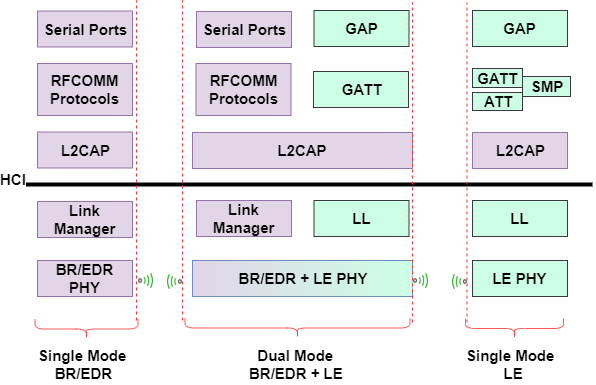
A Bluetooth module is far more than a radio on a PCB. Underneath the metal shield sits a complete Bluetooth Low Energy protocol stack that turns raw RF into services, characteristics, and secure connections. Understanding how that stack is layered helps engineering teams choose the right component and avoid costly redesigns.
The Two Big Halves: Controller and Host
Every Bluetooth LE implementation splits into a Controller and a Host. The Controller handles the radio: the Physical Layer (PHY) modulates bits onto 2.4 GHz, and the Link Layer manages advertising, scanning, and the connection state machine. The Host runs everything above the air interface – protocol logic, security, and the data model that applications actually use.
The Host Controller Interface (HCI)
Between the two halves sits the HCI. It is the command and event transport that lets a Host talk to a Controller over UART, USB, or SPI. A well-defined HCI means you can pair almost any Host stack with almost any Controller silicon. Many modern System-on-Chips merge both halves on one die, but the logical boundary still matters when you debug timing, power, or throughput problems.
Inside the Host Stack
Above HCI, several layers do the real work:
- L2CAP – multiplexes channels, fragments and reassembles packets, and provides the framing that upper layers rely on.
- GAP (Generic Access Profile) – controls discoverability, bonding, and the roles a device plays (broadcaster, observer, central, peripheral).
- ATT / GATT – the Attribute Protocol and Generic Attribute Profile define how data is organized into services, characteristics, and descriptors, each addressed by a UUID.
- SMP – the Security Manager handles pairing, key exchange, and encryption.
Why a Bluetooth Module Pays Off
Building this stack from scratch is a multi-year undertaking. A certified Bluetooth module ships with the stack pre-integrated, pre-tested, and pre-qualified under the Bluetooth SIG. That single decision removes RF tuning, protocol conformance, and most of the regulatory certification burden. For product teams, the module is the difference between a 3-month integration and a 2-year research project.
Choosing the Right Module
When evaluating a Bluetooth module, look past the headline data rate. Check which GATT roles it supports, whether it implements the security features your use case needs (LE Secure Connections, privacy, out-of-band), and how the vendor supports OTA firmware updates. A module that exposes a clean AT or host-API surface will shorten your firmware cycle far more than a few extra dBm of output power.
In short, the protocol stack is the invisible engine of every BLE product. Choosing a mature Bluetooth module lets your team focus on the application – not on re-implementing the radio.