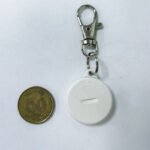
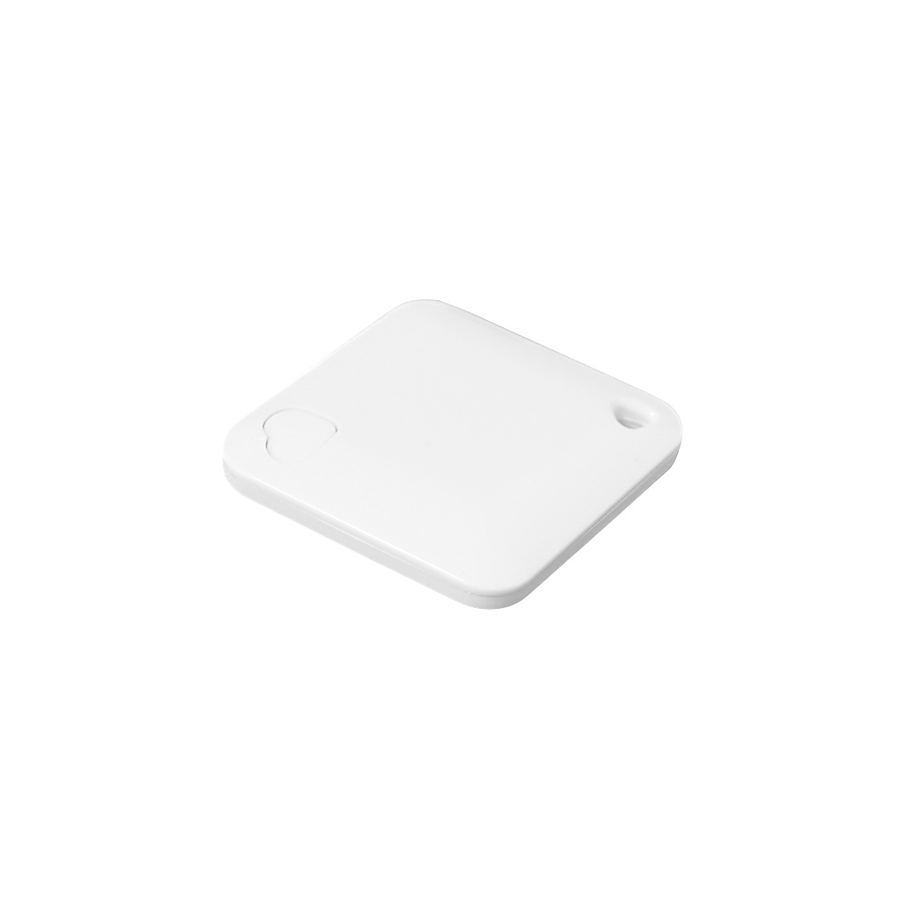
A suitcase goes missing at baggage claim. The BLE Tag inside it is broadcasting, but the phone that could find it is in another terminal. The owner walks past a help desk, taps their phone to a sticker, and the desk’s screen lights up with the bag’s last known gate. That sticker is NFC, and it just bailed out the Bluetooth radio that could not reach far enough.
Two short-range radios, one job
A BLE Tag talks at 2.4 GHz and reaches 30 to 80 meters, but only when a compatible reader is nearby and the battery is alive. NFC taps at 13.56 MHz and reaches 4 centimeters, but needs no battery on the tag side and works the instant two objects touch. They are not competitors. They cover each other’s blind spots: BLE for range, NFC for the moment range fails.
Tap to pair, no app friction
Pairing a BLE Tag to a phone usually means opening an app, scanning, waiting. With an NFC element on the tag, a tap hands the phone the tag’s MAC address, model, and a one-time key before the Bluetooth stack even wakes. First connect drops from twenty seconds to under two. For a returnable asset that changes hands daily — a rental tool, a loaner laptop — that tap is the difference between adoption and abandonment. The BLE Tag still does the tracking; NFC just removes the front door.
Anti-loss that actually works
A BLE Tag alerts you when you walk away, but only if the phone heard the last advertisement. Indoors, through a wall, the link drops and the alert is late or silent. NFC does not replace that. It adds a recovery path: a lost-item kiosk, a service counter, even another traveler’s phone can tap the object and read owner contact, last sync time, and a reclaim code. The BLE Tag tells you the thing is gone; the NFC lets a stranger return it without a call center.
Battery-free interaction
Here is the part people miss. A BLE Tag dies and becomes a brick. An NFC sticker glued next to it keeps working, because NFC is powered by the reader’s field — zero battery. Print the warranty QR, the asset ID, and a tap-to-register action on that sticker, and the object stays manageable for its whole life even after the radio quits. We spec the NFC element rated for 100,000 taps; the BLE Tag rarely outlives that many cycles anyway.
Sizing the NFC coil next to BLE
You cannot just glue an antenna beside an antenna. The NFC coil at 13.56 MHz and the BLE Tag’s 2.4 GHz trace sit inches apart, and a poorly placed coil degrades the Bluetooth range by 2 to 3 dB through coupling. Keep the coil at least 10 millimeters from the BLE antenna keep-out area, orient it orthogonal to the RF trace, and verify on a vector network analyzer. A fusion design that saves three cents on spacing costs meters of range. Measure, do not assume.
A retail returns story
An electronics retailer tagged loaner units with a BLE Tag plus an NFC sticker. Customers tapped to register at pickup — no app, no line. At return, a clerk tapped to confirm the unit and released the deposit in four seconds. Lost-loaner rate fell because the tap at pickup bonded the customer to the asset; the BLE Tag only mattered for the 2 percent that walked out untapped. The NFC did the human work. The BLE Tag did the finding.
Security of the tap
NFC is convenience and therefore a target. A blank sticker cloned at a returns desk lets an attacker mint fake “registered” assets. So the NFC element carries a signed record, not plaintext, and the BLE Tag’s one-time key is what the backend actually trusts. Tap reveals identity; the Bluetooth handshake proves it. Treat the NFC as a name tag and the BLE Tag as the passport, and a cloned sticker gets you a greeting, not a laptop.
The trade you accept
Fusion is not free. The NFC element adds a few cents and a millimeter of board space. The orthogonal coil placement constrains your mechanical design. And you now maintain two radios’ worth of certification. A BLE Tag that also speaks NFC is a more useful object and a more complicated one — worth it when the object changes hands often, worthless when it sits in one rack forever. Put NFC on the things that move. Leave it off the things that do not.