
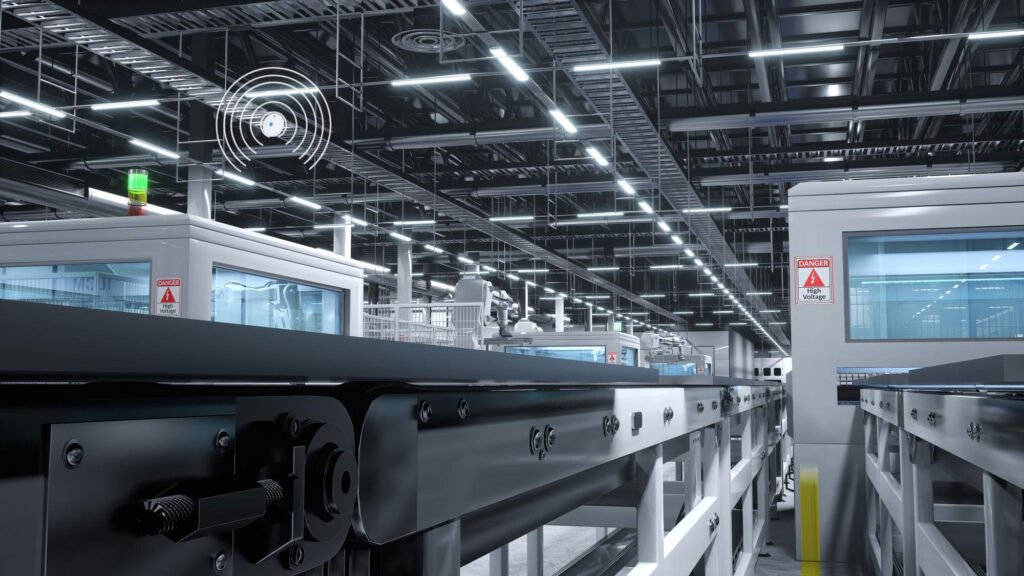
Industrial IoT and the Role of Bluetooth Beacons
Industrial environments — manufacturing plants, oil refineries, mining sites, and large logistics hubs — present some of the most demanding conditions for wireless technology: RF-hostile metal structures, hazardous areas, extreme temperatures, and requirements for real-time location accuracy measured in sub-meters. Bluetooth Beacon technology has emerged as a cost-effective solution for several key Industrial IoT use cases where GPS is unavailable and UWB is too expensive to deploy at scale.
This article examines five proven industrial applications, the technical constraints each imposes on beacon hardware and firmware, and the deployment patterns that have demonstrated reliable performance in production environments.
Use Case 1: Mobile Equipment and Vehicle Tracking
Large industrial facilities operate fleets of forklifts, pallet jacks, cranes, and specialized vehicles that need to be located in real time for dispatching, utilization tracking, and collision prevention. Beacon-equipped vehicles broadcast a unique identifier, while a fixed reader network installed on structural columns and overhead gantries triangulates position.
Key technical requirements for vehicle tracking:
- Update rate: 1–2 Hz minimum for collision avoidance applications; 0.1 Hz acceptable for utilization tracking.
- TX power: +4 to +8 dBm to overcome metal reflections and maintain 15–20 m reliable detection range.
- Mounting: Beacons mounted on vehicles must be vibration-rated (IEC 60068-2-64) and installed facing outward, away from metal chassis that would shield the signal.
- Power source: Vehicle-powered (12V or 24V supply through DC-DC converter) eliminates battery concerns and allows continuous operation.
Use Case 2: Worker Safety and Mustering
In hazardous industrial areas — chemical plants, mines, offshore platforms — knowing the real-time location of every worker is a safety-critical requirement. Each worker wears a personal safety beacon clipped to a hard hat or safety vest. Fixed readers log all beacons in their detection zone, maintaining a continuous headcount per zone.
| Feature | Requirement | Implementation |
|---|---|---|
| Zone detection latency | <5 seconds | Advertising interval 500 ms, 3-read confirmation |
| Battery life | >12 months (daily wear) | AAA cell at 0 dBm, 500 ms interval |
| Panic button | Hardware trigger + BLE alert | GPIO interrupt → change advertising payload, increase TX to +4 dBm |
| Muster roll call | All beacons accounted within 60 s | Emergency mode: interval drops to 100 ms, TX to +8 dBm |
| ATEX/IECEx rating | Zone 1 or Zone 2 (explosive atmospheres) | Certified hardware enclosure required |
Muster capability — the ability to account for all personnel during an emergency evacuation — is a critical feature. The system must transition from normal 500 ms advertising to an emergency 100 ms mode automatically when a plant-wide alarm is triggered, reducing the time to confirm all workers are accounted for to under 60 seconds.
Use Case 3: Tool and Calibrated Equipment Management
Precision tools, calibrated measurement instruments, and specialized fixtures represent significant capital investment in manufacturing. More critically, tools used past their calibration date or in unauthorized work areas can cause quality defects or safety incidents. Attaching a Bluetooth Beacon to each managed item enables:
- Calibration tracking: Beacon payload includes a calibration-due epoch timestamp (Unix time, 4 bytes). Fixed readers compare against current time and raise an alert if a tool is detected in a production area after its calibration date.
- Unauthorized use detection: Tools are assigned to specific work zones. A tool beacon detected outside its authorized zone triggers an alert in the MES (Manufacturing Execution System).
- Tool count verification: At shift end, a handheld reader scans all beacons in the tool crib. Missing tools generate immediate alerts before the next shift begins.
Form factor is critical for tool tagging: beacons must be mechanically robust (IK09 rating), no larger than a 20mm diameter puck to avoid interfering with tool operation, and attachable via industrial adhesive or machine screw mount.
Use Case 4: Environmental Monitoring with Sensor Beacons
Industrial processes often require continuous environmental monitoring across distributed points — temperature in a curing oven, humidity in a paint booth, vibration at a bearing housing. Deploying wired sensors to hundreds of monitoring points is expensive and inflexible. Sensor-equipped BLE beacons address this with wireless data collection.
A typical industrial sensor beacon payload for a machine health monitor:
- Node ID (4 bytes): Maps to physical location in the monitoring system
- Vibration RMS (2 bytes): mm/s, computed from MEMS accelerometer data over 1-second window
- Vibration peak frequency (2 bytes): Hz, FFT peak — correlates with specific mechanical faults
- Temperature (2 bytes): °C × 10, bearing surface or ambient
- Measurement timestamp (4 bytes): Unix epoch for time-series correlation
- Alert flags (1 byte): Threshold exceeded bits for each parameter
Vibration analysis is particularly valuable for predictive maintenance. A bearing in good condition generates broadband vibration. As it develops defects, characteristic frequencies emerge (ball pass frequency outer race, ball pass frequency inner race) at amplitudes 3–10 dB above the broadband baseline — detectable weeks before catastrophic failure.
Use Case 5: In-Process Material and WIP Tracking
Work-in-process (WIP) tracking — knowing where each batch, workpiece, or assembly is in the production flow — is essential for reducing cycle time and identifying bottlenecks. Beacons attached to carriers, fixtures, or product packaging broadcast their position as they move between workstations.
| Deployment Model | Accuracy | Latency | Infrastructure |
|---|---|---|---|
| Zone-based (workstation reader per zone) | Zone-level (~5 m) | 1–3 s | 1 reader per workstation |
| RSSI trilateration (dense reader grid) | 1–3 m | 2–5 s | 1 reader per 25 m² |
| Scan-on-pass (handheld / gate reader) | Point-in-time only | Real-time at gate | Gate readers at key transitions |
For most manufacturing WIP tracking applications, zone-level accuracy is sufficient — knowing that a batch is at workstation 7 versus workstation 8 is actionable. Sub-meter accuracy adds cost without proportional value in most cases.
RF Propagation Challenges in Metal-Rich Environments
Industrial environments present unique RF challenges that directly impact beacon deployment planning. Metal structures cause specular reflection and multipath fading that can completely null the BLE signal at specific locations. Practical mitigation strategies:
- Antenna diversity: Use beacons or readers with dual antennas and switched diversity. When the primary antenna path is faded, the secondary antenna path frequently has sufficient signal. Diversity gain of 5–8 dB is typical in cluttered metal environments.
- Frequency hopping adaptation: BLE uses adaptive frequency hopping across 37 data channels. In environments with strong narrowband interference (common near motor drives and welders), the frequency hopping algorithm maps out interfered channels within 30 connection events. For advertising-only beacons, this doesn’t apply — instead, ensure reader antennas are positioned away from major noise sources.
- Reader spacing reduction: In highly metallic environments, reduce reader spacing from the standard 10–12 m to 6–8 m and increase TX power to +4 dBm to compensate for the 5–10 dB additional path loss from metal reflections and absorption.
A well-engineered industrial Bluetooth Beacon deployment delivers persistent, sub-5-meter location accuracy across harsh production environments — providing the real-time visibility that drives operational efficiency improvements of 10–25% in pilot deployments documented across multiple industries.