
A maintenance shop told us they burned about forty hours a month looking for tools. Nothing was stolen. Everything was just somewhere else. Here’s what we put on them, what broke, and what the techs actually ended up using.
Start with the question, not the tag
“Where is it” isn’t one question. Do you need the building, the room, or the shelf? The answer changes the tag, the density, and the bill. For tools, room-level is almost always enough — nobody standing at a bench needs to know the wrench is at coordinate 4.2, they need to know it’s in Bay 3. Deciding that up front saved us from over-building the whole thing.
Pick a tag that survives the tool
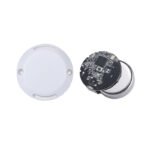
A BLE Tag on a torque wrench gets dropped on concrete, soaked in cutting fluid, and rattled around a drawer full of sockets. In that environment the IP rating matters more than the battery life, which is the opposite of how most spec sheets are ordered. We used a tag in a polycarbonate housing, and we riveted it rather than gluing it. The glue failed in three weeks.
Mounting is most of the job
A BLE Tag flat against metal is the worst case. The tool body detunes the antenna and eats the range — we measured roughly forty percent less distance with a tag flush on a steel case versus the same tag stood off five millimeters on a spacer. If the tool has a plastic handle, mount there. If it doesn’t, use a spacer. This one detail moved the system from “works sometimes” to “works.”
What the gateways need to see
Coverage, not precision. One gateway per bay or per room, ceiling mounted, with enough overlap that a tool shut inside a drawer still gets heard a few times an hour. We ended up at roughly one gateway per sixty square meters in the shop, denser than the office spec, because a workshop is metal everywhere and metal eats signal.
Tag the crib, not just the tool
This is the change that made the system useful. We put a BLE Tag on the shadow board and on the drawer as well as on the tool itself. Now the system knows not just where a tool is, but what’s missing from where it belongs. “Three things are out of the crib” is a sentence a supervisor can act on at shift change. “The 3/8 torque wrench is somewhere in building two” is not.
The software is where adoption dies
A list of four hundred tools is useless at seven in the morning. What the techs actually opened was a search box — type “3/8 torque” and get a room — plus a last-seen timestamp. We built a map view first because it looked good in the demo, and nobody opened it. Build the search box.
The number at the end
Forty hours a month down to under six. A BLE Tag ran about four dollars, roughly twelve hundred dollars for the whole shop, and it paid for itself in about five weeks. That payback came from the search box and the crib tagging, not from the hardware.
What we’d do differently
Rivet instead of glue. Stand the tag off metal. Tag the crib on day one. And build the search box before the map. None of those four are hard, and we got every one of them wrong the first time.